There is a moment at every catfish tournament weigh-in when somebody who has never competed before watches a 60-pound blue catfish come off a boat and thinks, I could do this.
You probably can. Tournament catfishing on the Santee Cooper lakes is more welcoming than most people expect, and Lake Moultrie is one of the best places in the country to try it. But your first event goes a lot better if you know how the format works before you are standing on the dock at midnight with a fish that will not fit in your bag.
Here is what to expect and how to get ready.
Why Santee Cooper is where people start
The Santee Cooper lakes are legitimately famous for blue catfish. Lake Moultrie and Lake Marion produce trophy-class fish consistently, and the system has a long, deep tournament culture around them.
Two things make it good for beginners. First, there are genuinely a lot of fish, so you are unlikely to get completely blanked. Second, the community is friendly — catfish tournament anglers are famously willing to talk to newcomers, which is not true of every fishing discipline.
How catfish tournaments actually work
Formats vary, but most events around here follow a similar pattern.
The format
Most tournaments are team events — typically two anglers per boat, sometimes three. You fish a set window and weigh a set number of fish, commonly your best three, five, or seven, depending on the event.
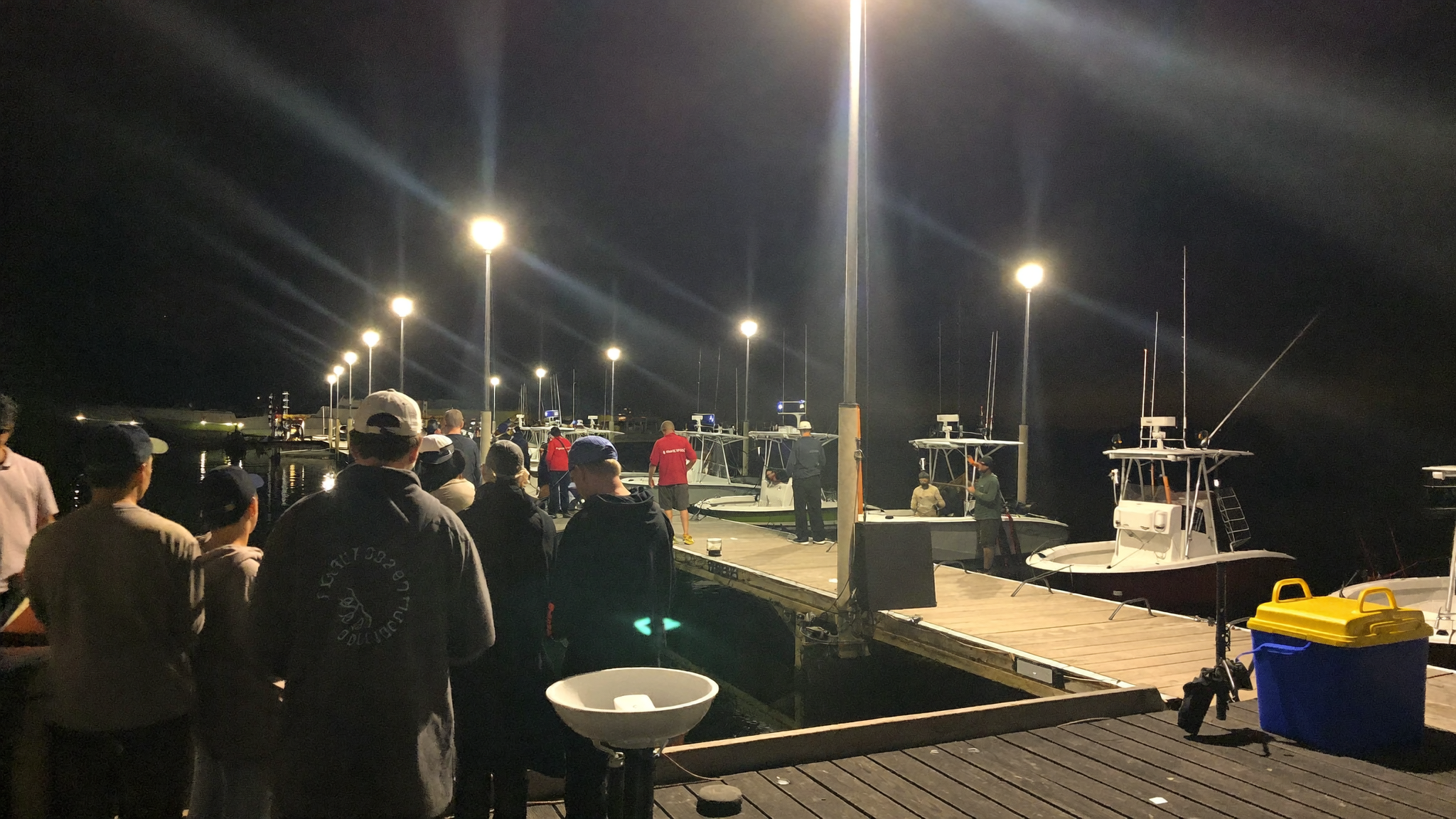
Many Santee Cooper events run at night or span overnight, because that is when big blues feed best. A typical schedule might be a captains’ meeting in the late afternoon, lines in at dusk, and weigh-in somewhere between midnight and sunrise.
Entry
Entry fees vary widely, from modest local club events to larger-purse tournaments. You register in advance or at the captains’ meeting, and you will usually need to show a valid South Carolina fishing license for every angler aboard.
The captains’ meeting
Do not skip it. This is where rules are confirmed, boundaries are set, safety requirements are checked, and any changes are announced. It is also the single best opportunity you will have to ask questions without anyone judging you for it.
Weigh-in
You bring your fish to the scales in the condition the rules require — often alive, with penalties or disqualification for dead fish. Most modern catfish tournaments are catch-and-release focused, and fish care is taken seriously.
The rules that catch first-timers out
Every experienced tournament angler has a story about a rule they learned the hard way.
- Check-in time is absolute. Being late by two minutes usually means disqualification, not a warning. Budget for a slow run back in wind.
- Dead fish penalties are real. If your livewell fails, your day is effectively over. This is the most common reason good catches do not count.
- Boundaries matter. Know exactly which waters are in play. Some events include both lakes and the connecting waters; some do not.
- Safety equipment is inspected. Life jackets for everyone aboard, working navigation lights, kill switch, throwable flotation, fire extinguisher.
- Bait rules vary. Some events restrict bait types or prohibit bait purchased from certain sources. Ask.
- Culling rules. Understand how and when you may swap a smaller fish for a larger one under that event’s rules.
Always read the specific rules for your event. Nothing in this article overrides what is on the tournament sheet.
Gear you actually need
You do not need a fully rigged tournament boat to enter your first event. You do need tackle that will not fail on a big fish.
Rods and reels
Heavy-action catfish rods in the 7 to 8 foot range, paired with reliable baitcasting or spinning reels with a smooth drag and real line capacity. A 50-pound blue will test cheap equipment immediately and expensively.
Line and terminal tackle
Heavy braided main line with an appropriate leader is standard. Circle hooks are the norm in catfishing — they hook fish in the corner of the mouth, which improves both hookup ratio and survival for release. We covered rigs in detail in our Santee Cooper catfish bait and rigs guide.
Rod holders
Multiple, and solidly mounted. Drifting or anchoring with several rods out is standard practice, and a big fish will take an unsecured rod over the side.
Livewell capacity
This is the piece beginners underestimate most. Keeping several large catfish alive for hours requires real water volume and aeration. Talk to other competitors about what works before you commit to an event with strict live-fish rules.
Landing and handling
A large landing net, a weigh sling, heavy-duty gloves, and long-nose pliers or a hook-out tool.
You can pick up hooks, line, sinkers, and terminal tackle at the Ship’s Store before you launch.
Bait strategy
Fresh, local, and oily is the short version. Gizzard shad, herring, and white perch are proven Santee Cooper baits. Fresh beats frozen almost every time, so many competitors spend the first part of tournament day catching bait with a cast net.
Plan for more bait than you think you need. Running out at 2 a.m. with three hours left is a bad way to finish.
Prepping in the weeks before
- Pre-fish the area. Nothing substitutes for time on the water. Fish the same water at the same time of day and night you will be competing.
- Service the boat. Check the motor, batteries, lights, and livewell pumps. Night events are unforgiving of electrical problems.
- Respool your reels. Old line is a false economy.
- Get comfortable running at night. If you have never navigated Lake Moultrie in the dark, do it once recreationally first. There is standing timber out there.
- Sort out your sleep. An overnight tournament after a full workday is harder than it sounds.
New to running this lake? Start with our Lake Moultrie boat ramps guide and our complete Lake Moultrie catfishing guide.
Fish care and release
The big blue catfish that make this fishery special take many years to grow. How competitors treat them determines whether that continues.
- Keep fish in the water as much as possible.
- Support large fish horizontally with two hands — never hang a big catfish vertically by the jaw.
- Wet your hands and gloves before handling.
- Keep livewell water aerated and reasonably cool.
- Revive fish properly at release, holding them upright until they swim off under their own power.
What to expect on tournament day
You will probably not win. Almost nobody wins their first event, and that is fine — that is not what the first one is for.
What you will get is a fast education. You will see how other teams rig, where they set up, how they handle fish, and how much of the sport is preparation rather than luck. You will also find that most competitors will happily explain what they are doing if you ask politely at the ramp.
Bring more food, water, and warm clothing than you think you need. Overnight on the water in the fall gets cold in a way that a warm afternoon does not prepare you for.
After the weigh-in
The tournament does not really end when the scales close. What happens in the hour afterward is where most first-timers learn the most.
Stick around. Watch how the top teams unload, how they handled their fish, what rods and rigs are actually on their boats rather than what people claim online. Ask a specific question rather than a general one — “what depth were you fishing?” gets a real answer far more often than “any tips?” does.
Then take twenty minutes the next day, while it is fresh, and write down what happened: where you set up and why, what depth and bait produced, what time the bite turned on or shut off, what you ran out of, and what broke. That log becomes genuinely valuable by your third or fourth event, because Santee Cooper rewards pattern recognition more than luck.
Finally, take care of your gear before you sleep. Rinse the reels, drain and clean the livewell, and get the rods out of the boat. It is the last thing you want to do at four in the morning and the thing you will be most glad you did.
Frequently asked questions
Do I need a special license to fish a catfish tournament in South Carolina?
You need a valid South Carolina freshwater fishing license. Some events have additional requirements, so confirm with the tournament organizer and check current regulations with the South Carolina Department of Natural Resources.
Can I fish a tournament without a big boat?
Often yes, as long as your boat is safe, legal, and meets the event’s requirements. Livewell capacity is usually the practical limiting factor, not boat size.
Are catfish tournaments catch and release?
Most modern events are release-focused, with penalties for dead fish. Always check the specific rules for your tournament.
When is catfish tournament season on Santee Cooper?
Events run through much of the year, but fall and winter draw a lot of interest because that is when the largest blue catfish feed most aggressively. See our Lake Moultrie fishing tournaments guide for how the calendar generally shapes up.
What size catfish does it take to be competitive?
It varies by event and season, but on a system like Santee Cooper, competitive teams are typically weighing multiple fish well into the double digits, with trophy fish considerably larger.
Start where the tournaments happen
Hidden Cove Marina has been part of the Lake Moultrie catfishing scene for a long time, and tournament anglers launch from here regularly. We have ramp access, the Ship’s Store for tackle and bait supplies, and Swig & Swine on site for the meal before a long night out.
If you are thinking about your first event, come talk to us. Somebody around here has fished it.