The Best Ways to Find and Rent a Boat Slip This Summer
Finding a Boat Slip Rental Near You This Summer
Boat slip rental near me is one of the most common searches boaters make when the weather heats up — and for good reason. A good slip means easy water access, secure storage, and more time actually enjoying the weekend instead of scrambling to plan it.
Here’s a quick answer to get you started:
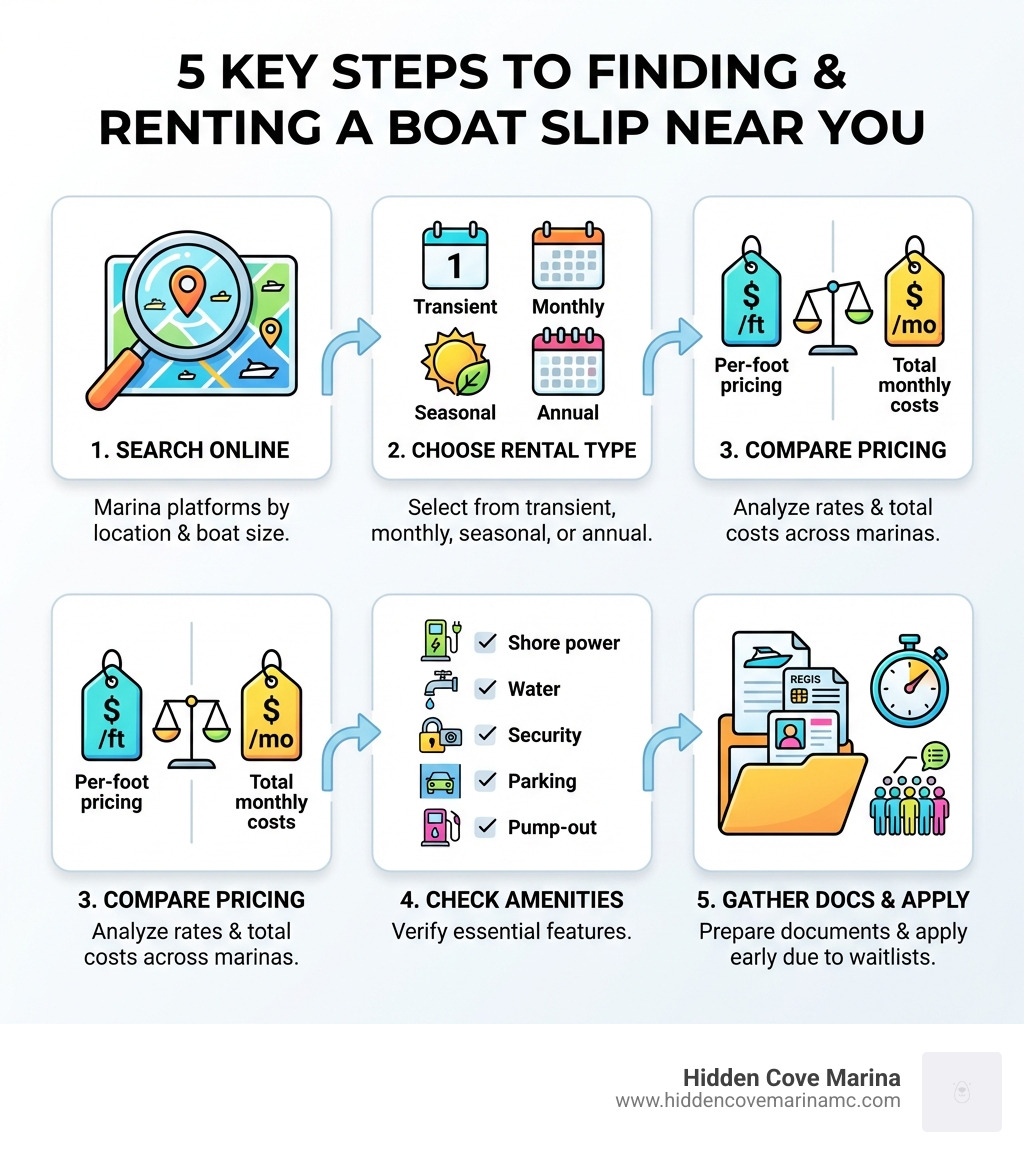
- Search marina booking platforms like Dockwa or DockSkipper to browse local slips by location and boat size.
- Contact your nearest marina directly — many offer transient (nightly), monthly, seasonal, and annual slip options.
- Compare rates by vessel length — most marinas price slips per foot, per night or per month.
- Check availability early — popular slips can have waitlists ranging from months to over a year.
- Ask about amenities — shore power, water hookups, parking, security, and pump-out service vary widely by marina.
Summer weekends on the water fill up fast. Whether you need a slip for a single afternoon, a holiday weekend, or a full season, knowing where to look — and what to expect — saves you time and stress.
Pricing varies a lot by region and boat size. A 30-foot slip might run around $720/month in some markets, while nightly guest slips at busier destinations can cost $90–$125/night. Annual contracts are often priced per foot per year, typically ranging from $185 to $215+ per foot depending on location and slip type.
This guide walks you through everything: how to find slips near you, what types are available, how pricing works, and what to bring when you apply.
How to Find a Boat Slip Rental Near Me
Finding the perfect spot for your boat doesn’t have to feel like navigating through a thick fog. The “old school” method of walking the docks still works, but most of us start our journey with a smartphone in hand.

Searching for a Boat Slip Rental Near Me by Destination
When you begin your search for a boat slip rental near me, the first step is narrowing down your destination. Are you looking for a home port near Moncks Corner, or are you planning a voyage down the Cooper River?
Online directories and marketplaces have revolutionized this process. Platforms like Dockwa allow you to filter by boat length, beam, and draft to ensure the slip actually fits your vessel. For those looking for more private arrangements, services like PierShare or DockSkipper connect individual dock owners with boaters, often providing unique spots that aren’t listed in traditional commercial marina directories.
Evaluating Marina Ratings and Reviews
Not all marinas are created equal. Before you sign a contract, it is vital to check what other captains are saying. We recommend looking for specific feedback on:
- Service Quality: Does the staff greet you warmly and help with lines?
- Facility Maintenance: Are the docks stable? Is the shore power reliable?
- Security: Do they have 24-hour video surveillance or locked gates?
- Amenities: Is there a clean restroom or a place to grab a bite, like a BBQ restaurant?
High ratings (think 4.7 to 5.0 stars) usually indicate a team that treats your boat as if it were their own. In our experience, the “heart and soul” of a great marina is the staff who ensure your boat is ready for the water the moment you arrive.
Understanding Different Types of Boat Slip Rentals
Depending on how often you use your boat and where you plan to go, you’ll need to choose the right “home” for your vessel.
Transient vs. Long-Term Rentals
| Feature | Transient Slips | Annual/Seasonal Contracts |
|---|---|---|
| Duration | Nightly or Weekly | 6 to 12 Months |
| Best For | Day trips, holidays, coastal cruising | Primary boat storage |
| Pricing | Per foot, per night (Higher daily rate) | Per foot, per year (Lower daily rate) |
| Availability | First-come, first-served or reserved | Often involves a waitlist |
| Utilities | Usually included in daily fee | Metered and billed separately |
For those who prefer to keep their boat in the water year-round, wet slip storage options provide the ultimate convenience. You simply show up, unhook, and go. If you prefer to keep your hull clean and out of the elements, dry stack boat storage is an excellent alternative where your boat is tucked away in a secure building and launched via forklift when you’re ready to ride.
Short-Term and Event-Based Boat Slip Rental Near Me
Planning to be on the water for the 4th of July or a specific fishing tournament? Short-term “guest slips” are designed for exactly this. Many marinas offer “Day Trip” rates where you can tie up for a few hours for free or a small fee to enjoy local dining and shopping. However, for major holidays, expect to pay a premium. Holiday rates can jump significantly—sometimes reaching $5.00 to $6.00 per foot per night—and often require a minimum stay of 2 or 3 nights.
Specialized Storage and Liveaboard Options
If you have a non-standard vessel, such as a catamaran, be prepared for “multihull surcharges.” Because these boats take up more horizontal space (the beam), marinas often charge 50% to 100% more than a standard monohull slip.
Additionally, if you plan to live on your boat, you must look for “liveaboard” friendly marinas. These are becoming rarer and often come with a monthly “liveaboard fee” (ranging from $200 to $500+) to cover the additional use of water, electricity, and waste facilities.
Pricing Factors and Typical Costs for Slip Rentals
Understanding the bill is often the most confusing part of renting a slip. Most marinas use a “Per Foot” model, but it’s not always just the length of your boat that counts.
How Pricing is Determined
- LOA (Length Overall): This includes your swim platform, bowsprit, and outboard motors. Marinas will charge you based on the LOA or the slip size, whichever is greater. If you put a 20-foot boat in a 30-foot slip, you’re likely paying for 30 feet.
- Base Rates: In popular coastal or river regions, annual rates often start around $185 per foot per year. For monthly rentals, you might see rates from $15 to $35 per foot per month.
- Leasehold Taxes: Don’t forget the government’s cut. Many regions include a leasehold tax (often around 12.84%) in the quoted monthly total.
Additional Fees and Surcharges
The base rent is rarely the final price. Keep an eye out for:
- Electric Charges: Most marinas charge a flat monthly fee for a “hookup” (e.g., $20 for 30-amp) plus the actual metered usage.
- Environmental Fees: Small monthly charges for sewage pump-out or oil disposal.
- Overhang Charges: If your boat sticks out past the end of the dock, you may be charged a per-foot “overhang” fee.
- Premium Slips: “T-Heads” or slips with easy “end-tie” access often carry a surcharge because they are easier to maneuver into.
Understanding Waitlists and Availability
If you are searching for a boat slip rental near me in a high-demand area like Moncks Corner or the Cooper River, you might encounter the dreaded waitlist.
- 32′ Slips: Average wait of 6 months.
- 40′ Slips: Average wait of 1.5 years.
- 50′ Slips: Average wait of 9 months to a year.
To get on a waitlist, you typically need to submit a formal application and sometimes a small deposit to hold your spot.
Amenities, Rules, and the Application Process
A marina is more than just a place to park; it’s a community with its own set of rules and perks.
Common Marina Amenities
When comparing marinas, look for these key features:
- Shore Power & Water: Ensure the pedestals are modern. Some newer GFCI compatibility requirements can cause issues for older boats that “leak” a bit of current.
- Security: Look for 24-hour video surveillance and gated access.
- Convenience: On-site boat landing access and a well-stocked Ship’s Store make a huge difference in your weekend prep.
- Recreation: The best marinas offer BBQ areas, picnic tables, and even on-site dining options.
Required Documentation for Renters
When you’re ready to sign, have your “boat resume” ready. Most professional marinas will require:
- Proof of Insurance: Typically a minimum of $300,000 in liability coverage, often naming the marina as “additional insured.”
- Registration: Current state registration or federal documentation.
- Photo ID: A valid driver’s license.
- Vessel Photo: A recent color photograph of the boat to ensure it meets the marina’s aesthetic and safety standards.
- Boating Safety Certificate: Depending on your state, you may need to show proof of a Boating Safety Certificate to operate motorized vessels.
Common Marina Policies and Restrictions
Every marina has a “code of conduct.” Common rules include:
- Pet Policies: Many allow one pet per boat, usually requiring them to be leashed at all times.
- Prohibited Boats: Some marinas do not allow wooden boats, houseboards, or boats over a certain age (e.g., older than 20 years) without a specific inspection.
- Commercial Bans: Most recreational slip agreements strictly prohibit using the boat as an Airbnb or for chartering without a commercial license.
- Parking: Parking is often first-come, first-served, so don’t expect a reserved spot right in front of your gate during busy holiday weekends.
Frequently Asked Questions about Boat Slips
What is the difference between a boat slip and a boat stall?
While the terms are often used interchangeably, a boat slip is like a parking space for a boat that is open on one end (the “entry”), allowing you to pull in. A boat stall or “berth” often refers to a more enclosed space, sometimes with fingers on both sides of the boat for extra stability and access.
How is the “Length Overall” (LOA) calculated for pricing?
LOA is the total length of your vessel from the furthest point on the bow to the furthest point on the stern. This includes outboard motors in the “down” position, swim platforms, and anchors. If your boat is 24 feet but your motor and pulpit add another 4 feet, you are effectively a 28-foot boat in the eyes of the dockmaster.
Conclusion
Finding the right boat slip rental near me is the key to an unforgettable summer on the water. Whether you are looking for the ease of a wet slip or the protection of dry storage, starting your search early and having your documentation ready will put you ahead of the crowd.
At Hidden Cove Marina, we pride ourselves on being the premier destination on the Cooper River. Serving the Moncks Corner community and Lake Moultrie, we offer top-notch facilities paired with genuine southern hospitality. After a long day on the water, there’s nothing better than docking your boat and heading straight over to Swig & Swine for some world-class BBQ right here at the marina.
Ready to secure your spot for the season? Explore our premier marina services and let us help you make this summer your best one yet. See you on the river!